Circular Fashion against Fast Fashion
Everyone’s talking about Shein these days…
In a world where environemental and societal questions are in center of the attention, the ultra fast fashion is paradoxally growing those last years, especially with huge companies like Temu and Shein.
It's no suprise that the fashion industry is one of the most polluting industry. So, let’s explore the fast fashion perfect opposite: Circular Fashion.
… maybe it’ll inspire a few people 🌱
Because yes, Karen can find a cute sweater in 100% acrylic for only 7$, but if she takes the time to go in Guerrisol or on Vinted, she could find a cute second-hand sweater in 100% wool for the same price.
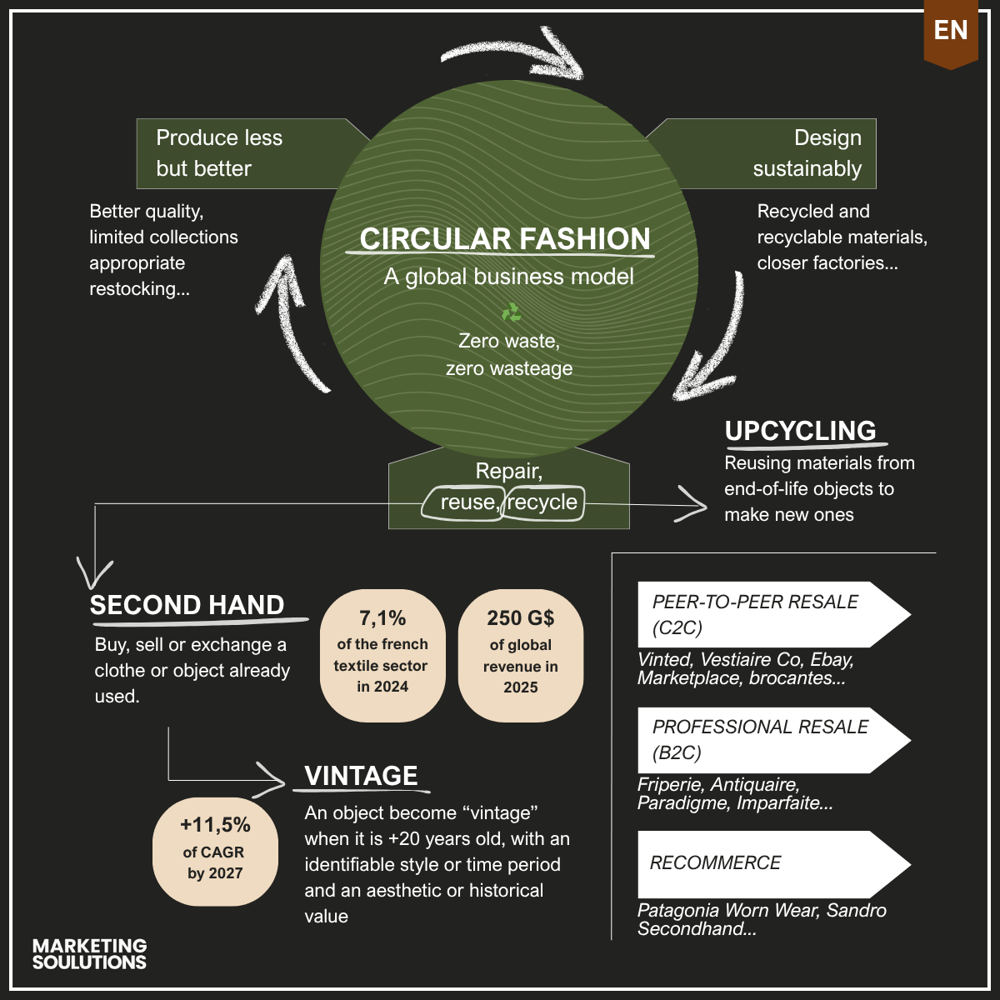
And it’s much more than just a trendy concept, it’s a new way of thinking about fashion, from design to end-of-life.
It’s a model built to close the loop and create without waste: Produce less, but better - Repair, reuse, recycle - Add value at every stage of the product’s lifecycle
This model brings together several ideas that are often mixed up, like :
- Upcycling : reusing materials from unused pieces to create new ones.
- Second-hand : giving clothes a second life.
- Vintage : when a second-hand piece is over 20 years old and tells the story of an era.
For context, the global second-hand market is growing 7 times faster than the new fashion market. By 2028, it could exceed $350 billion in value.
There are several resale models to know:
- Peer-to-peer resale : platforms like Vinted, eBay or LeBonCoin, making sustainable fashion accessible to everyone.
- Professional resale : thrift shops, vintage boutiques, or antique dealers (e.g. Episode, Kilo Shop, Guerrisol…).
- Re-commerce : when brands take back and resell their own products (e.g. Patagonia Worn Wear, Sandro Second Hand, Aigle Second Souffle…).
Interestingly, brands that integrate resale into their own websites find that “reseller” customers are 65% more loyal. And nearly 80% of Gen Z shoppers have already bought or sold a second-hand item. It’s the generation most sensitive to this kind of consumption, and to the environmental issues tied to it. Because extending the life of a garment by just 9 months can reduce its carbon footprint by 20 to 30%.
So how can we make the entire fashion industry circular ? And slow down (or ideally, eliminate) the rise of ultra-fast fashion?
I am very curious about your opinion ! Contact me and let's talk about it.